
Oil Temp for French Fries: 325°F First, 350°F to Finish
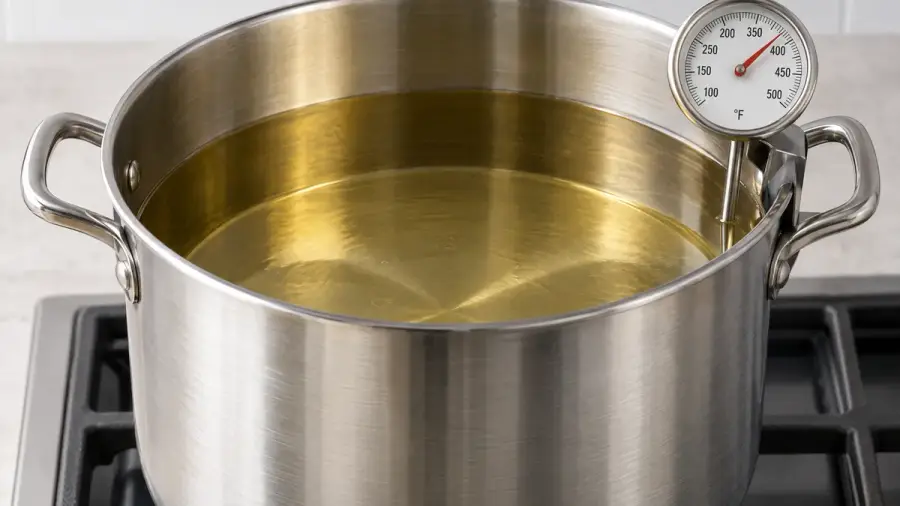
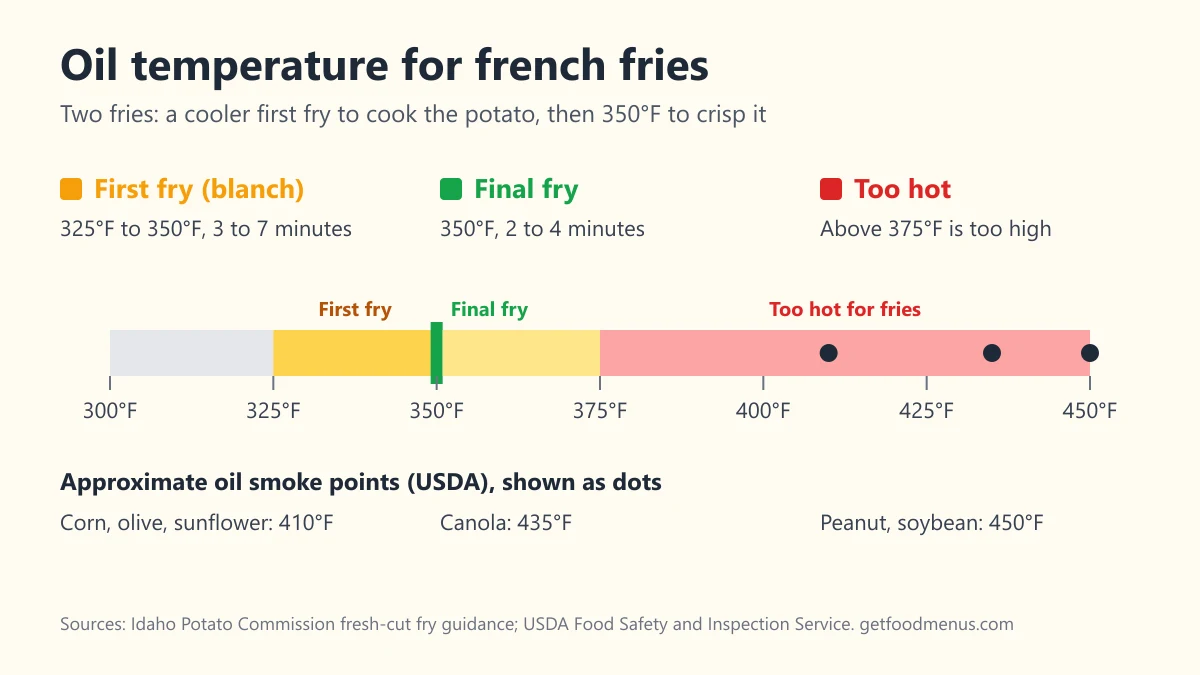
The oil temp for french fries is 350°F for the final fry. Fresh-cut fries are fried twice: a first fry at 325°F to 350°F cooks the potato through, then a final fry at 350°F for 2 to 4 minutes crisps the outside. The Idaho Potato Commission warns against going above 375°F at any point.
Those figures come from the Idaho Potato Commission's guides for fresh-cut fries. The oil and safety guidance comes from the USDA Food Safety and Inspection Service. Sources are listed at the bottom. For the whole process from potato to plate, see how to make crispy french fries.
French fry oil temperatures at a glance
| Stage | Oil temperature | Time | What it does |
|---|---|---|---|
| First fry, Russet Burbank | 350°F | 3 minutes | Cooks the potato through without browning |
| First fry, Russet Norkotah | 325°F | 5 to 7 minutes | Same, at a lower temperature for longer |
| Final fry | 350°F | 2 to 4 minutes | Removes more moisture and crisps the outside |
| Upper limit | 375°F | Never | Fries darken and the oil breaks down faster |
What temperature to fry french fries at, and why not hotter
It is tempting to turn the heat up for a crisper fry. The Idaho Potato Commission says the opposite. It lists frying at too high a temperature among the biggest mistakes kitchens make with fresh potatoes, and it is specific about the numbers:
- Anything over 375°F is too high.
- Several of its guides go further and tell cooks not to exceed 350°F, noting that most oil manufacturers now recommend 350°F as a maximum.
- Hotter oil breaks down faster, so it has to be replaced sooner.
Heat also cannot fix a potato problem. Potatoes that were stored too cold turn part of their starch into sugar, and those fries brown quickly, sometimes before the inside is cooked. Our guide to the best potatoes for french fries covers storage.
The first fry: lower and slower
The first fry, often called blanching, is where the potato is actually cooked. The Commission describes fries as completely cooked during this stage, at a lower temperature, so the potato cooks slowly without turning golden brown.
- Russet Burbank: 3 minutes at 350°F.
- Russet Norkotah: 5 to 7 minutes at 325°F.
- How to tell it is done: the fry bends, feels almost rubbery and is still light in color. The center has reached 160°F.
Some kitchens go lower still. The Commission's guides quote a chef who blanches for 5 minutes at 260°F, and a Chicago fry shop that blanches for 9 minutes at 275°F before a final fry of 2 minutes 45 seconds at 350°F.
After the first fry, let the fries cool to room temperature, then chill them uncovered before the final fry.
The oil cools when the fries go in
The temperature on the dial is not the temperature the fries cook at. The Idaho Potato Commission notes that the moment potatoes drop into hot oil they can pull the temperature down by 50 degrees or more.
- Fry small batches. In a fryer, fill the basket no more than half full. A half-full basket cooks faster than a full one, because a full one drives the oil temperature down.
- Fry one batch at a time unless your fryer recovers quickly. The Commission's benchmark for a good fryer is that the oil temperature recovers in just over two minutes.
- Overloading has a cost: the potatoes absorb more oil and come out limp.
How to measure oil temperature
Use a deep-fry thermometer clipped to the pot, or a fryer with a thermostat. The Commission suggests a simple test of any fryer: note the temperature before the fries go in, then check again two minutes later to see whether it has come back.
Which oil to use, and smoke points
The USDA recommends oils with a high smoke point for deep frying: olive, peanut, canola, corn, grapeseed, safflower, sunflower and vegetable oil. At the smoke point an oil starts to break down and can pick up a foul odor or taste.
| Oil | Approximate smoke point (USDA) |
|---|---|
| Peanut, safflower, soybean | 450°F |
| Grapeseed | 445°F |
| Canola | 435°F |
| Corn, olive, sesame seed, sunflower | 410°F |
Every oil on the list smokes at 410°F or higher, well above the 350°F used for fries.
Keeping the oil in good shape
- Keep water out. The Commission names water, air, overheating and a build-up of food particles as the main causes of oil breakdown. Dry the fries well before frying.
- Skim loose pieces of potato out of the oil as you cook.
- Do not salt over the pot. Salt that falls into the oil breaks it down faster.
- To reuse it, the USDA says to strain the cooled oil through cheesecloth or a sieve and store it in a sealed, light-proof container for up to 3 months.
- Throw it out if it is cloudy, starts to foam, or smells or tastes off. Good oil looks clear and clean.
Safety at frying temperature
The USDA's rules for deep frying at home apply every time:
- Frying oil can reach more than 400°F. Never leave it unattended.
- Water that hits oil at about 350°F turns to steam instantly and makes the oil splatter. Keep water away from the pot.
- Keep a kitchen fire extinguisher nearby. Never put water on a grease fire: cover the pot with a metal lid or use the extinguisher, and call 911.
- Use a deep, heavy pot or skillet. The USDA advises against cast iron because it breaks oil down faster than other metals.
Sources
- Idaho Potato Commission: How to Make the Best "Signature" Fresh French Fries, Ten steps to better homemade Idaho Potato french fries, Should we Blanch our Idaho Potatoes?, French Fried Potatoes, The Best Hand-Cut Idaho French Fry Yield, To Create Perfect French Fries It's Important To Always Blanch Them and Q&A: How to Make Perfect French Fries. These guides were written for restaurant kitchens.
- USDA Food Safety and Inspection Service: Deep Fat Frying and Food Safety.